
Strawberry Plant Care: How to Grow Strawberries in Pots
Strawberry plant care in pots is easier than most people think. With strong sun, steady watering and a wide container, a few plants on a balcony, patio or sunny windowsill can give you handfuls of sweet, red berries for months, no garden bed required.
In this guide, you’ll learn which type of strawberry to choose, when to plant, which pot and soil to use, how to water and feed, what to do with flowers and runners, when to harvest and how to fix the most common problems.
Which strawberry to grow in a pot
Not every strawberry suits a container. Varieties fall into three groups, based on how they respond to day length:
| Type | How it fruits | For pots |
|---|---|---|
| June-bearing | One large crop over 2 to 3 weeks | Not recommended: lots of plant for one short harvest |
| Day-neutral | Flowers and fruits in waves for months | The best choice for containers |
| Everbearing | Two or three smaller crops a year | Works well |
Iowa State University Extension says June-bearing types are not recommended for containers and prefers day-neutral and everbearing types. It lists day-neutral ‘Albion’, ‘Cabrillo’, ‘Everest’ and ‘Seascape’, plus everbearing ‘Ozark Beauty’.
University of Wisconsin Extension agrees that day-neutral plants are the easiest in containers. They fruit in their first season and are more productive than older everbearing types. The University of Nebraska adds ‘Tristar’ to the day-neutral list and ‘Quinault’ and ‘Eversweet’ to the everbearing one.
When to plant strawberries in pots
Strawberries like mild weather. In most of the US, containers are planted in spring. Iowa State suggests early to mid-April for its region and recommends bringing pots indoors if frost threatens. The University of Nebraska says to plant as soon as the soil can be worked in early spring.
- Cold-winter areas: plant in early spring, after the hardest frosts.
- Mild-winter areas: early spring works, and fall planting is common where winters stay mild.
- Hot-summer areas: plant early so the plants fruit before the heat, and give afternoon shade in summer.
Heat is the big limit. Iowa State explains that day-neutral types stop flowering and fruiting above 80 to 85°F and start again when it cools down. A midsummer pause is normal, not a sign that something is wrong.
The best container for strawberries
Strawberries have shallow roots, so surface area matters more than depth. Iowa State and the University of Nebraska give the same minimum:
- Round pot: at least 12 inches wide and 8 inches deep. A 12-inch pot holds 3 or 4 plants.
- Long planter: at least 24 inches long, according to Wisconsin, which notes that long, narrow containers yield more than round ones.
- Spacing: about 8 inches between plants, as Iowa State recommends.
- Drainage holes: a must. Standing water rots the roots.
Strawberry jars with side pockets and hanging baskets also work, with a catch. Iowa State warns that the pockets dry out faster than the top and that hanging baskets get very hot, and hot soil makes berries smaller.
Light-colored pots are a smart choice in hot climates. A report from Embrapa, Brazil’s agricultural research agency, found that soil under black plastic reached 104°F or more in summer (in Portuguese), while white plastic kept it near 86°F. Above that, the researcher said, strawberry roots die. Dark pots in full sun heat up the same way.
Short on floor space? Strawberries are a natural fit for wall planters. See how to set one up in our guide to a vertical garden in an apartment.
The best soil for strawberries in pots
Iowa State recommends a good all-purpose potting mix, and the University of Nebraska suggests mixing in compost. Nebraska also gives a slightly acidic target: pH 5.5 to 6.5.
A simple mix that works:
- 2 parts quality potting mix;
- 1 part compost or worm castings;
- a handful of perlite to keep it light.
If the potting mix has no starter fertilizer, Iowa State suggests mixing in an all-purpose fertilizer following the label. Always start with fresh mix. Nebraska advises against planting where tomatoes, peppers or eggplant grew, since they share diseases. Have a compost bin? See how to use compost in pots.
How to plant a strawberry, step by step
Growing strawberries from seed is slow and tricky. The easy route is bare-root or potted plants from a nursery, or runners from a plant you already have.
- Water the plant an hour before planting. Soak bare-root plants briefly.
- Fill the pot with mix to about an inch below the rim.
- Dig a hole as big as the root ball, or deep enough to fan out bare roots.
- Set the crown height. The crown is the thick center where the leaves come out. Iowa State and Nebraska say it should sit even with the soil surface.
- Firm the soil around the roots without burying the crown.
- Water well until it drains from the holes.
Crown height is where most beginners go wrong. Buried, the crown rots. Set too high, the roots dry out.
Light: strawberries need sun
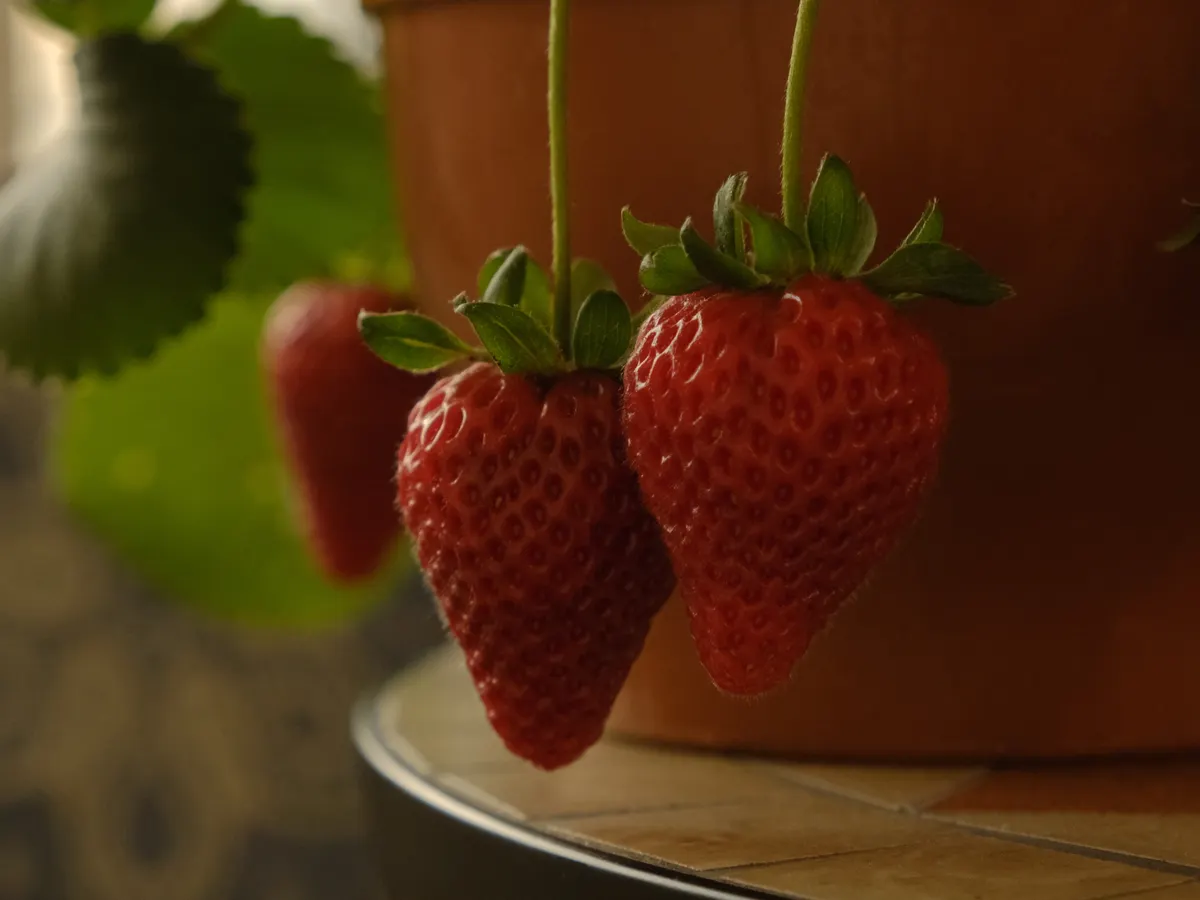
Without enough sun, a strawberry plant grows leaves but very little fruit. Iowa State recommends at least 6 hours of direct sun a day, and Nebraska says 6 to 8 hours.
- Best spot: a south- or west-facing balcony, patio or window.
- In very hot areas: full morning sun with some afternoon shade keeps plants flowering longer.
- Indoors: only right next to a sunny window. If light is weak, a grow light helps; see our guide to grow lights.
How to water strawberries in pots
Watering is the point every extension service stresses. Wisconsin notes that containers dry out faster than garden beds, and Iowa State says to keep the soil consistently moist, watering when the surface is dry. In summer heat, that can mean once or even twice a day.
- Push a finger about an inch into the soil.
- If it’s dry, water slowly until it drains out the bottom.
- Water the soil, not the leaves and berries.
- Empty the saucer after 15 minutes.
Wet leaves and fruit invite mold, and Nebraska also recommends watering at the base. If leaves turn yellow and the soil stays soggy, you may have the opposite problem; see how to fix overwatered plants.
A thin layer of straw on top of the soil holds moisture and keeps berries off wet soil. The University of Maryland notes that straw is the traditional strawberry mulch.
How to fertilize strawberries in pots
Strawberries fruit for months and need steady feeding. Extension advice lines up closely:
- University of Nebraska: a balanced liquid fertilizer every 4 to 6 weeks in the growing season.
- Iowa State: 2 to 3 times per season, ideally right after you harvest a flush of fruit.
- University of Maryland: once a month, May through September, for day-neutral types.
In practice, a light monthly feeding while the plant flowers and fruits works well. Go easy on nitrogen, or you’ll get lots of leaves and few berries. For homemade options, see our guide to homemade fertilizer for potted plants. Thinking of adding eggshells? First read what eggshells can and can’t do for plants.
Flowers and runners: what to remove
Two simple habits make plants stronger and more productive:
- First flowers: Iowa State recommends removing the first flush of spring blooms. Maryland suggests pinching day-neutral flowers for the first 4 to 6 weeks after planting. The plant puts that energy into roots, and later flowers come back stronger.
- Runners: these long stems form baby plants at the tip. Iowa State suggests keeping only 1 or 2 per plant and cutting the rest, since they pull energy from the fruit.
Want more plants for free? Pin a runner’s baby plant into a small pot of soil without cutting it from the mother plant. After about 3 weeks, once it has firm roots, snip the stem. It works on the same idea as propagating from cuttings: the new plant roots before it’s separated.
When to harvest strawberries
The University of Maryland says berries ripen about 5 weeks after bloom. The right moment is easy to spot:
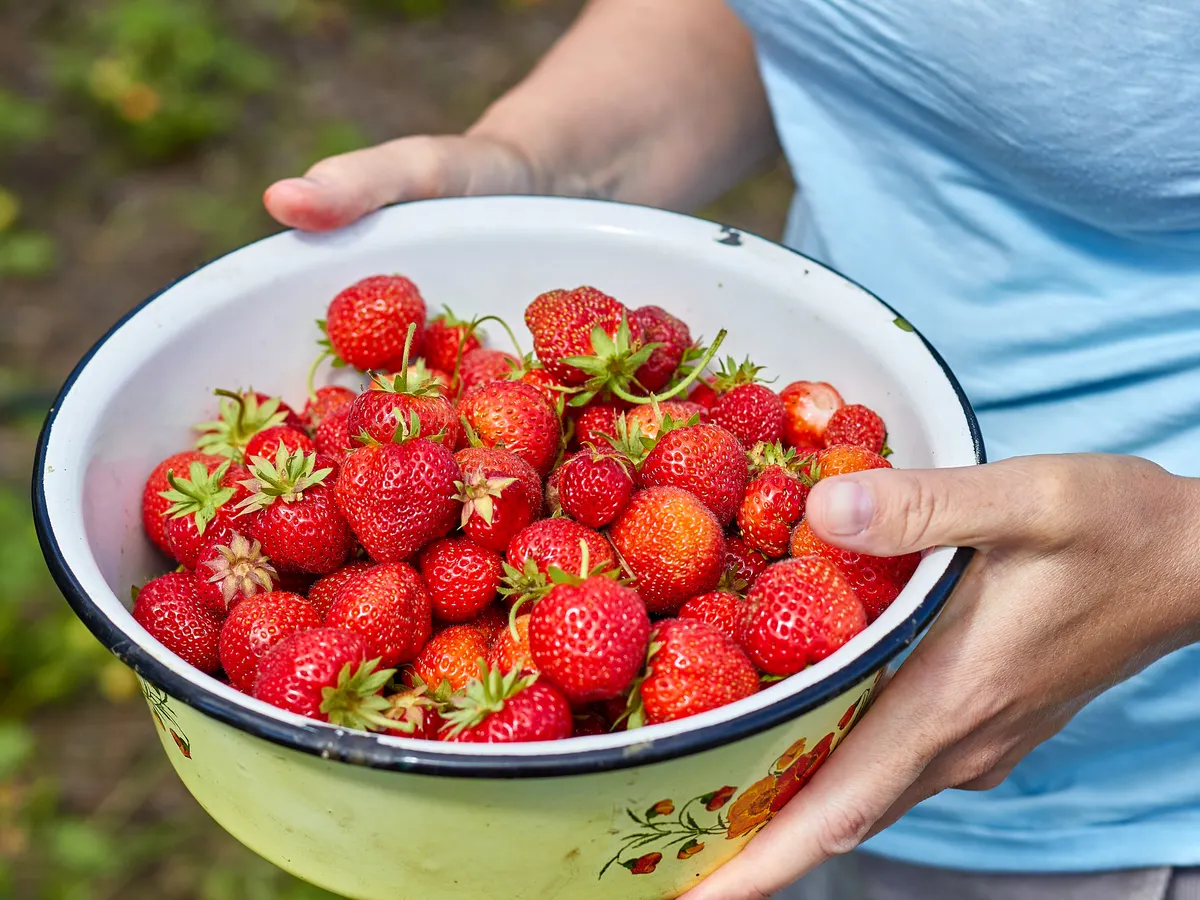
- Color: red all over, with no white near the cap.
- Timing: Maryland suggests leaving berries on the plant 1 to 2 days after they turn fully red, for more sweetness.
- How: cut the stem about 1/4 inch above the berry with scissors, leaving the green cap attached, as Iowa State recommends.
- How often: check every 1 to 2 days during the season.
Picking early doesn’t pay. The University of Nebraska explains that strawberries do not ripen after picking. Refrigerate for 3 to 5 days and wash only right before eating.
Overwintering strawberries in pots
Containers leave roots exposed to cold. Iowa State does not recommend overwintering container plants in cold climates: it suggests composting them and replanting in spring, since they are highly prone to winter damage.
If you want to try, Nebraska suggests moving pots to an unheated garage or shed and watering them occasionally. In mild-winter areas, plants can often stay outside with a layer of straw. Wisconsin suggests deciding each fall whether to keep the plants or start fresh.
How long a strawberry plant lasts
Strawberries are perennials, but they only produce well for a few years. Nebraska puts it at about 3 to 4 years. Maryland is more direct for container growers: plant new plants every three years.
Many container gardeners treat strawberries almost like annuals: enjoy the harvest, refresh with rooted runners and replace the soil.
Common problems and how to fix them
| Problem | Likely cause | What to do |
|---|---|---|
| Lots of leaves, few berries | Too little sun or too much fertilizer | Move to 6+ hours of sun and feed less |
| Stopped flowering in summer | Heat above 80 to 85°F | Afternoon shade; fruiting resumes when it cools |
| Small berries | Hot pot, dry soil or too many runners | Light-colored pot, steady water, trim extra runners |
| Gray fuzz on berries | Gray mold, favored by moisture | Remove affected fruit, water the soil only, improve airflow |
| White powder on leaves | Powdery mildew | Improve airflow and remove affected leaves |
| Speckled leaves with fine webs | Spider mites | Spray water under the leaves; insecticidal soap |
| Holes in berries | Slugs or birds | Handpick slugs at night; net the plants as fruit ripens |
Nebraska lists aphids, spider mites and slugs as common pests, and gray mold, powdery mildew and root rot as common diseases. It suggests insecticidal soap or neem oil for insects. Iowa State recommends removing diseased leaves and fruit as soon as you see them. For more natural fixes, see our guide to plant pests.
Growing strawberries with other plants
Strawberries pair well with other sun-loving container crops, but each should have its own pot:
- Cherry tomatoes and peppers need bigger pots and share diseases with strawberries, so don’t reuse their soil.
- A Meyer lemon tree looks great nearby and also loves strong sun.
- Herbs like mint taste great with strawberries but need their own pot, because they spread.
To plan a full edible corner, see our kitchen herb garden guide.
- For pots, choose day-neutral or everbearing strawberries, such as ‘Albion’ or ‘Seascape’.
- Plant in early spring in most of the US.
- Use a pot at least 12 inches wide and 8 inches deep, with drainage, ideally light-colored.
- Set the crown exactly at soil level.
- Give at least 6 hours of direct sun a day.
- Keep the soil evenly moist and water at the base.
- Feed lightly every 4 to 6 weeks while plants are fruiting.
- Pinch the first flowers and keep only 1 or 2 runners per plant.
- Harvest fully red berries and replace plants about every 3 years.
With sun, steady water and a wide pot, a few strawberry plants can keep you in sweet berries for months, picked at their best.
Strawberry plant care FAQ
When should I plant strawberries in pots?
In early spring in most of the US. In mild-winter areas, fall planting also works.
What size pot do strawberries need?
At least 12 inches wide and 8 inches deep, with drainage holes. That size holds 3 or 4 plants.
How much sun do strawberry plants need?
At least 6 hours of direct sun a day. With less light, they grow leaves but little fruit.
How long until strawberries produce fruit?
Day-neutral plants fruit in their first season. Each berry ripens about 5 weeks after the flower.
Should I cut strawberry runners?
Most of them. Keep 1 or 2 per plant, since runners take energy away from the fruit.
Why is my strawberry plant not producing fruit?
The usual causes are too little sun, summer heat, too much fertilizer or a June-bearing variety in a small pot.
Can strawberries stay in pots over winter?
In cold climates it’s risky. Move pots to an unheated garage or replant in spring. In mild areas, mulch with straw.
How long do strawberry plants last in pots?
They produce well for about 3 years. After that, replace them with new plants or rooted runners.