Grow Garlic in Pots: When to Plant, Care and Harvest
Growing garlic in pots works surprisingly well, even on a balcony or patio, as long as you get three things right: the right type of garlic, the right planting time and plenty of sun.
Each clove you plant in fall becomes a full new bulb by early summer, and you can snip a few green leaves for cooking along the way.
In this guide, you’ll learn which garlic to plant, when to plant it, what size container to use, the best soil, how to water and feed it, how to know when it’s ready and how to cure and store your harvest.
Hardneck or softneck: which garlic to grow
There are two main types of true garlic, and choosing the one that suits your climate is the first step to good bulbs.
| Type | What it’s like | Best for |
|---|---|---|
| Hardneck | Stiff central stalk, fewer but larger cloves, easy to peel, produces edible scapes; stores 3 to 4 months | Cold-winter regions |
| Softneck | Flexible stem, many cloves, no scapes in most types, can be braided; stores 6 to 8 months | Mild climates; the most adaptable type |
Washington State University Extension explains that hardneck types are the most cold-hardy, while softnecks are the most adaptable and grow in a wide range of climates. Popular picks include ‘German Red’ and ‘Spanish Roja’ (hardneck) and ‘Inchelium Red’ and ‘Susanville’ (softneck).
You may also see elephant garlic. WSU notes it isn’t true garlic but a close relative of leeks, with huge, mild cloves.
Can you plant grocery-store garlic?
It may sprout, but it’s not the best choice. The University of Illinois Extension explains that supermarket garlic is often a variety adapted to milder climates and stored in ways that don’t favor good bulb formation.
WSU adds another reason: grocery garlic may carry diseases that persist in soil for years. Certified seed garlic, sold by garden centers, catalogs and local growers, is grown specifically for planting and is free of pests and diseases.
If you do use grocery garlic, use it for garlic greens instead. Those sprout easily, and you’ll find out how below.
When to plant garlic in pots
Garlic needs a cold period to form good bulbs. Illinois Extension recommends planting in fall, usually one to two weeks after the first killing frost. Roots grow before winter, and the bulbs form in response to the longer, warmer days of late spring.
- Cold regions: early to mid-fall, from September to October.
- Mild-winter regions: late fall, around November. WSU uses this split for eastern and western Washington.
- Missed fall planting: the University of Nebraska–Lincoln says you can plant very early in spring, in March or April. Softnecks handle spring planting better, but bulbs are usually smaller.
Reading this in late fall? There’s often still time. As long as you can plant before the soil in your pot freezes solid, your garlic can root in.
What size container does garlic need?
Garlic roots are fairly shallow, but bulbs need room to swell. Choose a pot or planter at least 8 inches deep, and deeper is better in cold regions, with drainage holes.
| Container | About how many cloves |
|---|---|
| 12-inch round pot | 4 to 6 cloves |
| 24 x 8-inch window box | 8 to 10 cloves, in 2 staggered rows |
| Half barrel or large grow bag (about 24 inches wide) | 15 to 20 cloves |
These counts follow WSU’s spacing of 4 to 6 inches between plants. Crowd them more and the bulbs come out smaller.
Large pots also hold more soil, which helps buffer the roots against hard freezes. Fabric grow bags and plastic planters both work well.
The best soil for garlic in containers
Illinois Extension says garlic grows best in well-drained soil high in organic matter, and that it has a moderate to high need for nitrogen.
A simple container mix:
- 2 parts quality potting mix;
- 1 part finished compost or worm castings;
- 1 part perlite for drainage.
The University of Nebraska explains why garlic is so demanding: its roots lack the tiny root hairs that help most plants absorb nutrients. It needs a steady, fairly high level of nutrients in the soil while actively growing. That matters even more in pots, where nutrients wash out with each watering.
Homemade compost is perfect here. If you compost at home, see our guide to apartment composting.
How to plant garlic in a pot, step by step
- Break the bulb apart on planting day, keeping the papery skin on each clove. WSU recommends planting large, clean, dry cloves the same day you separate them.
- Pick the biggest cloves. Illinois Extension notes that larger cloves usually grow larger bulbs. Use the small ones in the kitchen or for greens.
- Plant each clove pointed end up, flat side down, so the tip sits about 2 inches below the soil surface.
- Space cloves 4 to 6 inches apart.
- Water thoroughly to settle the soil and get roots started.
- Mulch the top with 3 to 4 inches of weed-free straw or shredded leaves, as WSU suggests, to protect from cold and hold moisture.
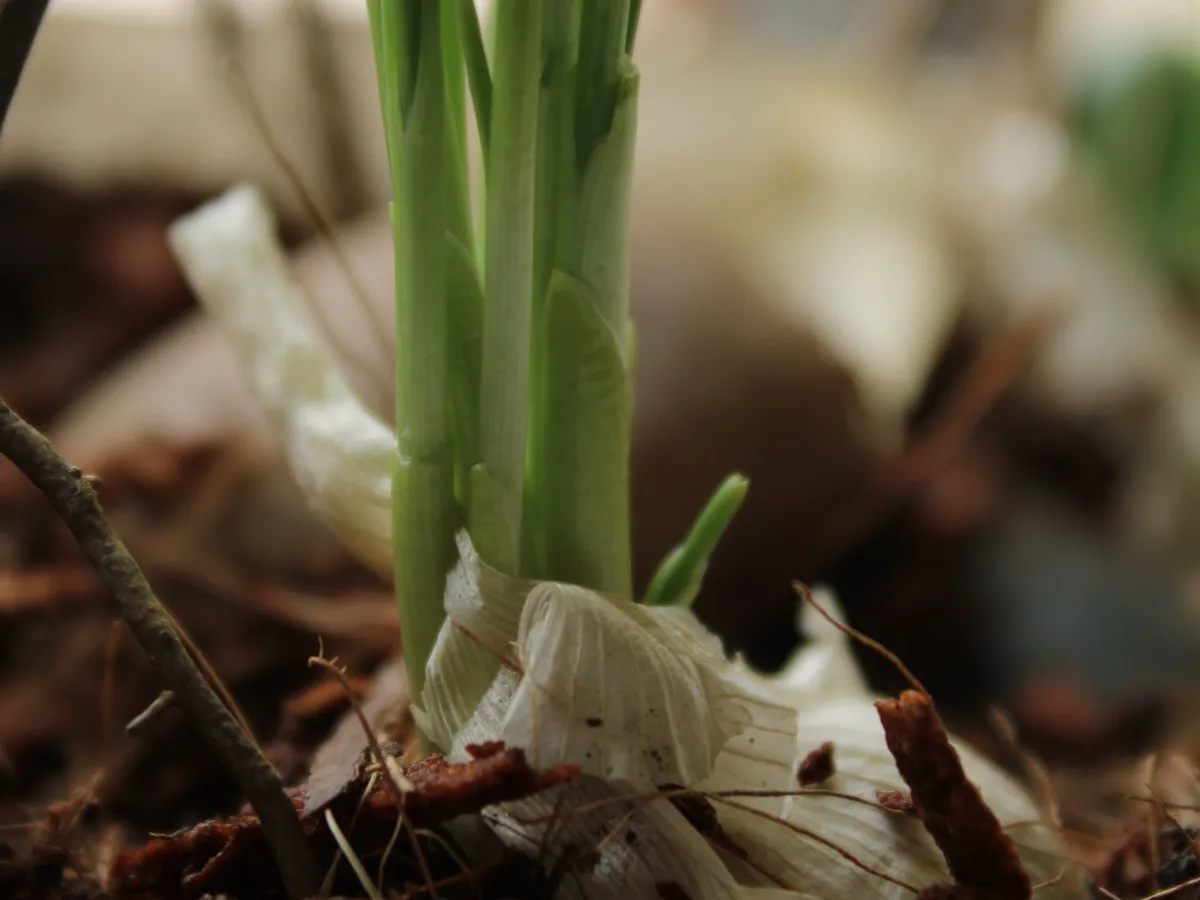
Green shoots may poke through before winter or not until spring. Both are normal.
Protecting potted garlic in winter
Garlic in the ground is well insulated by the earth around it. A pot is more exposed, because cold reaches the roots from every side.
- Use the largest container you can and keep a thick mulch layer on top.
- Group pots together against a sheltered wall, out of drying winter wind.
- In very cold zones, move the pot to an unheated garage or shed during deep freezes. Garlic still needs cold, so don’t bring it into a warm house.
- Check the soil occasionally during thaws. It shouldn’t stay soggy or dry out completely.
When temperatures warm in spring, move the pot back into full sun and pull back some of the mulch.
Light: garlic needs full sun
WSU calls for full sun, at least 6 hours of direct light a day. In shade, leaves grow thin and floppy and bulbs stay small.
- Best spot: a sunny patio, deck or balcony with direct light most of the day.
- In the Northern Hemisphere: south-facing spots get the most sun.
- Not enough sun: a grow light can help with greens indoors. See our guide to grow lights for herbs.
How to water garlic in containers
Garlic is shallow-rooted and sensitive to dry soil. Illinois Extension notes that both drought and overly wet conditions reduce yields.
- Check the soil with your finger before watering.
- If the top inch is dry, water until it drains from the bottom.
- Empty the saucer so roots don’t sit in water.
The most critical period is bulbing, roughly May and June. Nebraska Extension points out that dry soil during this stage leads to irregularly shaped bulbs. WSU suggests about an inch of water per week in spring and early summer.
Then the rule flips: stop watering 2 to 4 weeks before harvest, when the leaves begin to yellow and flop. This helps the wrappers firm up and the bulbs store longer.
Yellow leaves in constantly wet soil point to too much water. See our guide to overwatered plants.
How to fertilize garlic
| When | What to do |
|---|---|
| At planting | Mix compost or worm castings into the potting mix |
| Early spring, tops 6 to 8 inches tall | Side-dress with compost, as WSU recommends |
| A few weeks later | A light feeding with a nitrogen-rich organic fertilizer |
| Once bulbs start to swell | Stop feeding |
Nebraska Extension says several light nitrogen feedings work better than one heavy dose, and warns that too much nitrogen late in the season makes garlic store poorly. For DIY options, see our guide to homemade fertilizer for potted plants.
Garlic scapes: cut them or not?
Hardneck garlic sends up a curly flower stalk called a scape in late spring. WSU explains that removing it lets the plant put more energy into the bulb, so you get bigger heads.
Snip the scape just above the top leaf when it starts to curl. Don’t toss it: scapes are tender and delicious in pesto, stir-fries and eggs. Most softnecks don’t make scapes, so don’t worry if yours doesn’t.
Garlic greens: a bonus harvest
While bulbs grow, you can snip a few leaves and use them like scallions in eggs, rice and sauces. They taste like a gentle garlic.
- Take only one or two leaves per plant at a time.
- Never cut them all: the leaves feed the bulb.
- For greens only, plant small cloves 1 inch apart and cut freely. This works any time of year, indoors or out, even with grocery garlic.
Garlic greens work a lot like green onions in a pot, which regrow after cutting.
When and how to harvest garlic
Illinois Extension gives the signal: harvest when the lower leaves turn brown, ideally when half or slightly more than half of the leaves are still green. Too early gives small bulbs that don’t store well. Too late and the cloves start to split out of their skins.
- Stop watering 2 to 4 weeks ahead.
- Loosen the soil around the bulb with your hands or a trowel.
- Lift the whole plant gently by the base, keeping leaves and roots attached.
- Brush off loose soil. Don’t wash the bulbs.
Not sure? Dig gently around one plant to check. Nebraska Extension says a mature bulb is fully segmented and still covered by a tight outer skin.
How to cure and store garlic
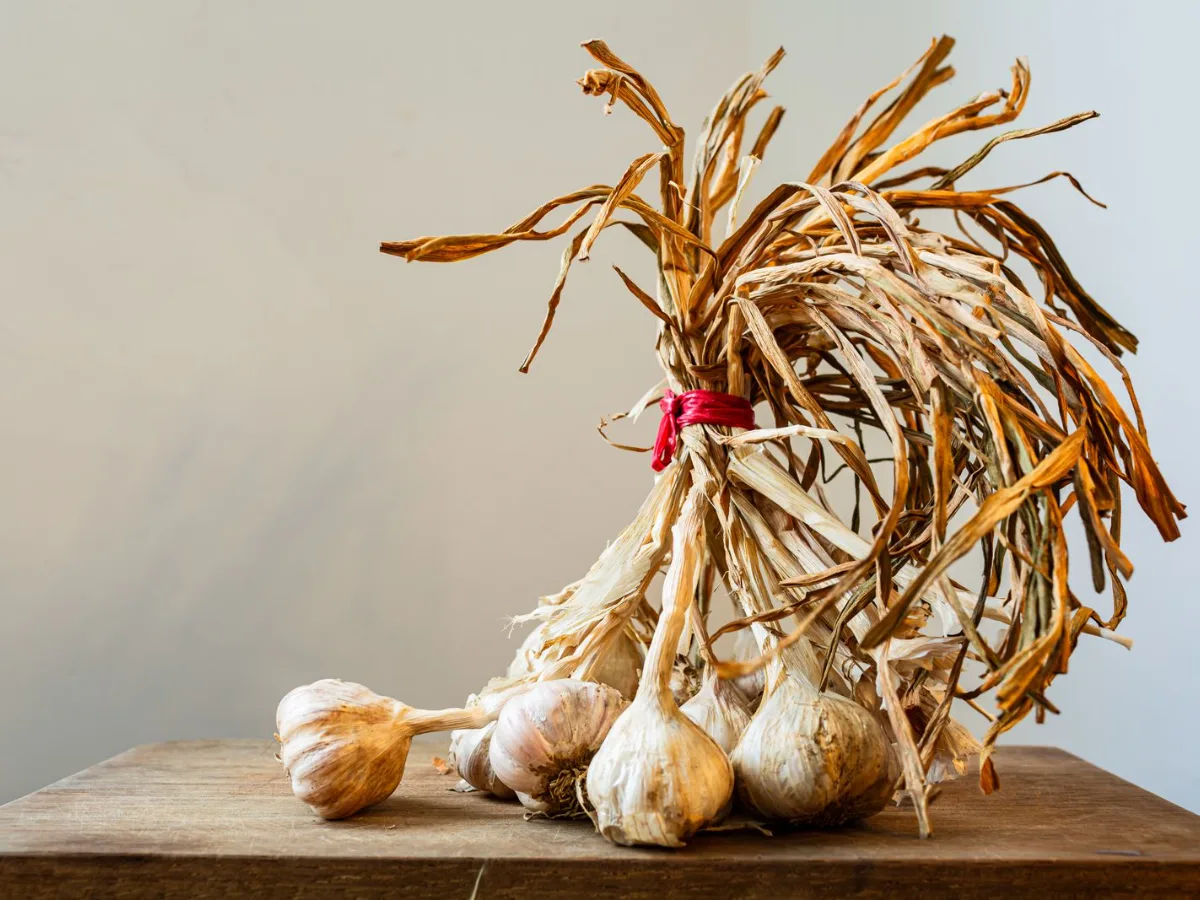
Freshly dug garlic needs to cure, or dry slowly, before storage. Illinois Extension recommends letting whole plants cure for about 3 to 4 weeks in a dry, shaded area with good air circulation.
- After curing: trim tops to about an inch above the bulb and cut the roots close.
- Where to store: a cool, dry, dark spot in mesh bags or baskets.
- Not the fridge: Nebraska Extension notes that garlic starts sprouting at 42 to 52 °F, right where most refrigerators sit.
- Braids: softneck stems can be braided while still flexible.
Save your best bulbs to replant in fall. Year after year, you’ll build up garlic that’s better adapted to your own conditions.
Common problems and fixes
| Problem | Likely cause | What to do |
|---|---|---|
| One round bulb, no cloves | Spring planting or not enough cold | Plant in fall next time |
| Small bulbs | Too little sun, crowding or small cloves | Full sun, 4 to 6 inches apart, large cloves |
| Yellow leaves mid-season | Low nitrogen or overwatering | Side-dress with compost and check drainage |
| Soft, rotting cloves | Soggy soil | Water less and improve drainage |
| Bulbs split open | Harvested too late | Dig when about half the leaves are still green |
WSU notes that garlic suffers more from diseases than insects, and that starting with certified, disease-free seed garlic prevents most problems. If thrips or mites appear, see our guide to getting rid of plant pests naturally.
Keep garlic away from pets
The ASPCA lists garlic as toxic to dogs and cats. It can cause vomiting and damage to red blood cells. If you have curious pets, keep the pot out of reach.
Garlic fits nicely into a container garden with other kitchen favorites. See which plants share space well in herbs that grow well together, and try growing ginger for summer, when the garlic pots are empty. To plan a full setup, start with our kitchen herb garden guide.
- Choose certified seed garlic: hardneck for cold winters, softneck for mild climates.
- Plant in fall, about one to two weeks after the first killing frost.
- Use a container at least 8 inches deep with drainage holes and compost-rich mix.
- Plant large cloves pointed end up, 2 inches deep and 4 to 6 inches apart.
- Mulch well and protect pots from deep freezes.
- Give at least 6 hours of direct sun and steady moisture in spring.
- Stop watering 2 to 4 weeks before harvest and dig when half the leaves are brown.
- Cure for 3 to 4 weeks in shade and store somewhere cool and dry, not the fridge.
Plant a pot this fall, and by early summer you’ll be pulling up your own garlic, with fresh greens and scapes along the way.
Frequently asked questions about growing garlic
When is the best time to plant garlic?
In fall, usually one to two weeks after the first killing frost. In mild regions, that’s often around November.
Can you grow garlic from a grocery-store bulb?
It may sprout, but it often forms poor bulbs and can carry disease. Use certified seed garlic for bulbs and grocery garlic for greens.
How deep should a pot be for garlic?
At least 8 inches deep, with drainage holes. Deeper, larger pots protect roots better in cold winters.
How deep do you plant garlic cloves?
With the tip about 2 inches below the soil, pointed end up, and 4 to 6 inches between cloves.
How long does garlic take to grow?
About 240 days from a fall planting, according to WSU. Fall-planted garlic is usually harvested from late June to mid-July.
How do you know when garlic is ready to harvest?
When the lower leaves have turned brown and about half the leaves are still green. Stop watering 2 to 4 weeks before.
Why didn’t my garlic form cloves?
Usually because it was planted in spring or didn’t get enough cold. Plant in fall for a full bulb with cloves.
Can you eat garlic leaves?
Yes. Snip one or two leaves per plant at a time and use them like scallions. Don’t cut them all, since they feed the bulb.