Cherry Tomatoes in Pots: Complete Guide From Planting to Harvest
Want to learn how to grow cherry tomatoes in pots and pick sweet little tomatoes right on your balcony or patio? Cherry tomatoes are one of the easiest ways to start growing tomatoes at home: they take up little space, grow fast and keep producing for months.
In this guide, you’ll learn which type to choose, the right pot, and how to plant, stake, water, feed, harvest and fix the most common problems.
Let’s take it step by step: first, the types of cherry tomatoes that work best in containers. Then the pot, the soil, planting, staking, watering, feeding, harvesting and the most common problems.
Which cherry tomato should you grow in a pot?
“Cherry tomato” covers many small-fruited tomatoes. There are round red ones, oblong grape types, yellow ones and pear-shaped ones. They all grow well in containers. The difference that matters most for home growers is how the plant grows.
| Plant type | How it grows | Best for |
|---|---|---|
| Determinate (bush) | Stops at a set height and ripens most of its fruit at once | Smaller pots, small balconies and low-maintenance growing |
| Indeterminate (vining) | Keeps growing and produces a little at a time for longer | Large pots with a tall stake, and anyone who wants months of harvest |
University of Minnesota Extension explains that bush plants stop growing and ripen a set number of fruits within four to six weeks, while vining plants keep flowering and ripening fruit until the weather turns cold. For containers and small spaces, the same source says bush types may be the only option.
Most cherry tomato seed packets are vining types, so read the label before you buy. If you’re short on space, look for varieties described as “compact,” “dwarf” or “patio.”
What do cherry tomatoes need to grow well?
Tomato plants need five things: lots of sun, warm weather, steady water, a pot with room for the roots and support for the branches. Here’s a summary:
| What it needs | How much | Practical tip |
|---|---|---|
| Sun | 6 or more hours of direct sun | Your sunniest balcony, patio or window |
| Temperature | Tolerates about 50 °F to 93 °F | Avoid cold snaps and extreme heat waves |
| Water | Evenly moist soil | Water deeply when the surface dries |
| Pot | 5 gallons or more, 12 to 16 inches deep | Always with drainage holes |
| Soil | Loose and rich in organic matter | Potting mix with compost |
| Support | Stake or cage from day one | Tie stems with soft strips |
University of Illinois Extension defines full sun as at least six hours of sunlight, and that’s what tomatoes need to flower and set fruit. Tomatoes are heat-loving plants: they grow best through warm summer days and suffer in frost.
Light also affects flavor. Brazil’s agricultural research agency, Embrapa, notes that low light during growth is linked to hollow fruit with less sugar (in Portuguese). In other words, a shady tomato may still grow, but the fruit won’t taste as sweet.
What pot and soil should you use for cherry tomatoes?
Pot size has the biggest effect on your harvest. A small pot dries out fast, crowds the roots and weakens the plant. NC State Extension recommends a minimum 5-gallon container for tomatoes, with one plant per container and a depth of 12 to 24 inches.
- One plant per pot: 5 to 7 gallons for vining types.
- Compact varieties: can manage in 3-gallon pots, but they’ll need water more often.
- Drainage holes: a must. Roots sitting in water will rot.
- Material: plastic and glazed pots hold moisture longer, which helps in hot weather. Terracotta dries out faster.
- Color: very dark pots can overheat in strong sun. Lighter colors are a safer choice.
Use a good-quality potting mix and blend in some compost or worm castings. Don’t use plain garden soil, which compacts in containers. Fill the pot to about an inch below the rim so water doesn’t spill over when you water.
If you compost at home, finished compost makes a great boost. See how to use compost in pots for amounts and timing.
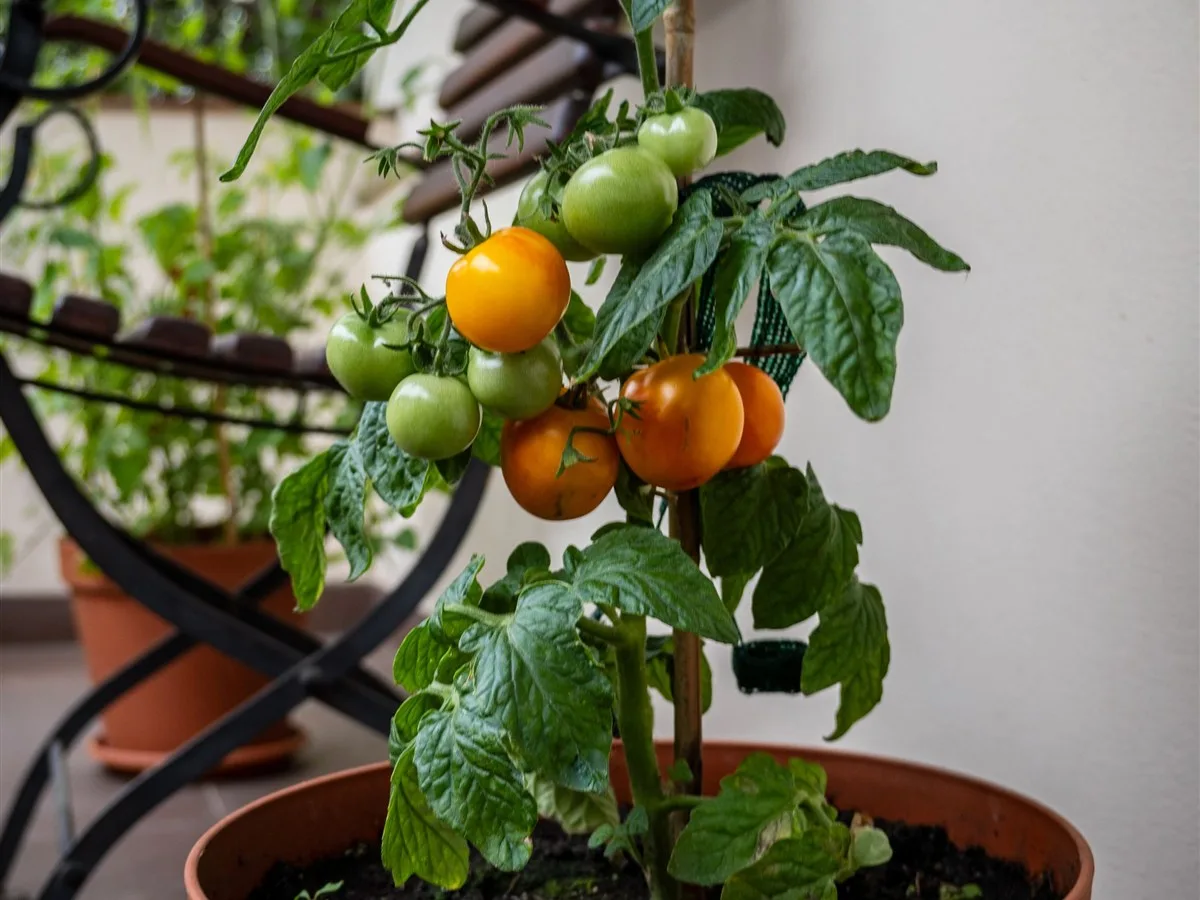
How to plant cherry tomatoes in a pot: transplant or seed
You can start with a nursery plant or from seed. A transplant is faster and easier. Seed is cheaper and gives you many more varieties to choose from.
1. From a nursery plant
- Choose a sturdy plant with a thick stem and deep green leaves, with no spots, flowers or bugs under the leaves.
- Put the stake in first, pushing it deep into the pot. That way you won’t damage the roots later.
- Plant it deeper than it was growing, burying part of the stem. Remove any leaves that would end up underground.
- Firm the soil gently and water until it runs out of the drainage holes.
- Keep it in light shade for two or three days so it can adjust, then move it into full sun.
Why bury the stem? University of Minnesota Extension explains that when part of the stem is below the soil line, new roots will emerge from the buried part, giving you a stronger, more vigorous plant. This trick works for tomatoes, but not for most other plants.
2. From seed
Tomato seeds sprout easily in warmth. University of Minnesota Extension suggests starting them indoors five to six weeks before planting outside, about a quarter inch deep, and notes that a heat mat keeping the tray at 75 °F to 85 °F gives the best germination.
- Use small cups or seed trays filled with fine, moist seed-starting mix, with drainage holes.
- Sow two or three seeds per cup, about a quarter inch deep.
- Keep the mix moist and warm in a bright spot. Seeds usually sprout in one to two weeks.
- Keep only the strongest seedling in each cup once the first true leaves appear.
- Move it to its final pot after your last frost, once the seedling is sturdy and about 4 to 6 inches tall.
If your seedling gets tall and thin, it needs more light. For the full process and the most common mistakes, see how to grow herbs from seed. The same rules apply to tomato seeds.
How to stake cherry tomatoes and remove suckers
Cherry tomatoes carry lots of clusters, and branches flop under the weight. That’s why they need support. University of Minnesota Extension recommends that you stake or cage plants at the time of planting, before the roots spread.
- Stake: a sturdy bamboo or wooden stake, 5 to 6 feet tall for vining varieties.
- Cage: a wire frame around the plant. Works well for bush types; choose one that fits inside the pot.
- Ties: use soft fabric strips or twine in a figure-eight loop, never tight around the stem.
- When to tie: University of Illinois Extension suggests starting to tie the plant when it’s about 12 inches tall and adding ties as it grows.
What are suckers?
Between the main stem and each leaf, small shoots called suckers appear. If you leave them all, they turn into new stems and the plant becomes a tangle. University of Illinois Extension recommends removing suckers so the leaves get full sun.
With cherry tomatoes, you don’t have to remove every one. Embrapa recommends training cherry types on three to four stems (in Portuguese). In a pot, keep two or three strong stems and pinch off the other suckers while they’re small. Bush types need little or no pruning.
How often should you water cherry tomatoes in pots?
Watering is the trickiest part of growing tomatoes. Embrapa points out that tomato plants demand a lot of water, but the soil can’t stay waterlogged either (in Portuguese). Flowering and fruit growth are the stages when a lack of water does the most harm.
- Finger test: push a finger into the soil up to the second knuckle. If it’s dry, water.
- Water deeply: keep going until water drains out the bottom.
- In hot weather: a large plant in a pot may need water every day, sometimes twice.
- Water the soil, not the leaves: Embrapa notes that constantly wet leaves raise the risk of fungal disease.
- Empty the saucer: standing water under the pot rots roots.
Consistency is the secret. Swinging between dry and soaked soil leads to split fruit and blossom-end rot. If leaves turn yellow while the soil is always wet, see signs of overwatered herbs, because the symptoms are the same.
How to fertilize cherry tomatoes in pots
Tomato plants produce for months and need food, but at the right time. The biggest mistake is too much nitrogen, such as fresh manure or high-nitrogen fertilizer. University of Minnesota Extension warns that too much nitrogen leads to plants that are bushy, leafy and slow to bear fruit.
- At planting: mix compost or worm castings into the potting mix.
- When the first fruits start to enlarge: that’s the time to feed, as University of Minnesota Extension advises. Two or three tablespoons of worm castings on top of the soil every two to four weeks works well for a 5-gallon pot.
- During fruiting: potassium-rich amendments, like composted banana peels or a little wood ash, support the fruit.
- Never use fresh manure: it can burn roots and carry bacteria.
Want to make your own fertilizer? See the options and amounts in homemade fertilizer for herbs. The same fertilizers work for tomatoes, which can handle slightly larger doses.
Flowers and fruit: what to expect
Tomato plants start flowering a few weeks after going into their pot. The flowers are yellow and grow in clusters. Every flower that sets becomes a tomato.
Tomato flowers pollinate themselves, but they need a little movement to release pollen. Outdoors, wind and insects take care of it. Indoors or on an enclosed porch, gently tap the stem and flower clusters in the morning once or twice a week.
Some flower drop is normal. If many flowers fall, the usual causes are extreme heat, too little or too much water, and not enough sun. Embrapa lists flower drop among the problems caused by excess water (in Portuguese).
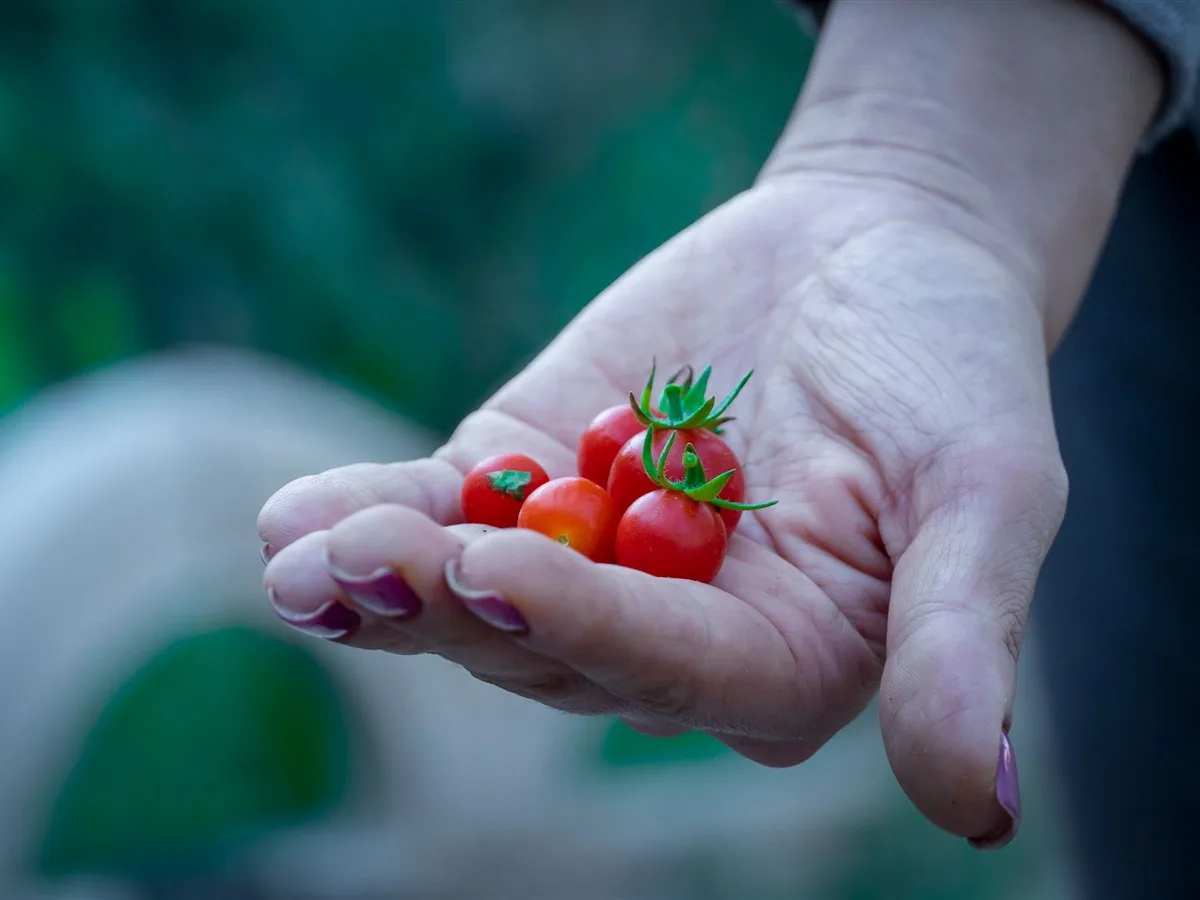
When and how to harvest cherry tomatoes
Time to first harvest depends on the variety and the weather. In general, the first cherry tomatoes are ready two to three months after transplanting. The seed packet usually lists the “days to maturity” for that variety.
University of Minnesota Extension says to harvest fruit when it reaches a usable size and color, and that most types come off the plant easily when ripe. Depending on the variety, ripe cherry tomatoes can be red, yellow, orange or even dark purple.
- Pick every day or two: cherry tomatoes ripen fast and split if left too long.
- Pick when it’s cool: Embrapa recommends harvesting during the coolest part of the day (in Portuguese) so the fruit doesn’t lose water.
- You can pick early: tomatoes keep ripening after picking. Before heavy rain or frost, pick the ones that have started to change color and let them finish indoors.
- Whole clusters: if most of a cluster is ripe, snip the whole thing with scissors.
How to store your harvest
Ripe cherry tomatoes keep their flavor best at room temperature and last a few days on the counter. In the fridge they last longer but lose some aroma. A good rule: keep what you’ll eat in two or three days on the counter, and refrigerate the rest.
What are the most common cherry tomato problems in pots?
Most problems come from water, sun or fertilizer being off. Use this table to find the cause:
| Sign | Likely cause | What to do |
|---|---|---|
| Lots of leaves, few tomatoes | Too much nitrogen or too little sun | Stop high-nitrogen feeding and move to more sun |
| Dark, sunken spot on the bottom of the fruit | Blossom-end rot, linked to uneven watering | Keep soil evenly moist and remove affected fruit |
| Split fruit | Uneven watering or heavy rain after dry spells | Water consistently and pick as soon as fruit ripens |
| Flowers dropping | Extreme heat, water problems or low light | Even out watering and tap the flower clusters |
| Yellow lower leaves | Overwatering, low nutrients or old leaves | Check drainage, feed lightly and remove old leaves |
| Curled, sticky leaves | Aphids or whiteflies | Spray with water or use diluted mild soap |
University of Minnesota Extension explains that blossom-end rot can develop when soil moisture levels fluctuate during fruit growth. It isn’t a disease that spreads from plant to plant, and it improves with steady watering.
To identify insects and treat them without harsh chemicals, see the guide to herb plant pests. If the leaves are changing color, see herb leaves turning yellow.
Can cherry tomatoes grow indoors?
They can, but only right next to a window that gets many hours of direct sun. In low light, the plant stretches, weakens and barely sets fruit. If your home is on the dark side, a tomato will struggle. In that case, choose herbs that grow in low light and save the tomato for the balcony or patio.
If the plant is tall, thin and sparse, see the signs of low light in leggy herbs.
What to plant with cherry tomatoes
Basil is the classic tomato companion, in the garden and on the plate. Both love sun and warmth. In a large pot, you can tuck a basil plant near the edge of the tomato. See how to grow basil in a pot.
Peppers belong to the same family as tomatoes and need similar care: sun, warmth and steady watering. Give each one its own pot, though. See how to grow peppers in pots.
Common mistakes when growing cherry tomatoes in pots
- Pot too small: the soil dries out in hours and the plant produces little.
- Not enough sun: without 6 hours of direct sun, few flowers appear.
- Skipping the stake: branches flop and snap under the weight of the clusters.
- Uneven watering: causes split fruit and blossom-end rot.
- Wetting the leaves: encourages fungal disease.
- Too much nitrogen: lots of leaves and few tomatoes.
- Leaving every sucker: on vining types, the plant becomes a tangle with poor airflow.
- Choose compact varieties for smaller pots and vining types for large ones.
- Use a pot of 5 gallons or more, with drainage holes.
- Tomato plants need 6 or more hours of direct sun.
- Plant transplants deeper, burying part of the stem.
- Add the stake at planting and tie stems loosely.
- Water consistently, wetting the soil and not the leaves.
- Feed when the first fruits start to grow, without overdoing nitrogen.
- Pick often so the plant keeps producing.
With a tomato plant on your balcony, your salads get tomatoes picked minutes before dinner. To build out the rest of your garden, see the kitchen herb garden guide.
Frequently asked questions about cherry tomatoes in pots
What size pot do cherry tomatoes need?
At least 5 gallons, 12 to 16 inches deep, with drainage holes, for one plant. Compact varieties can manage in 3-gallon pots.
Do cherry tomatoes need full sun?
Yes. Tomato plants need at least 6 hours of direct sun a day to flower and produce sweet fruit.
How long until cherry tomatoes produce fruit?
Usually two to three months after transplanting, depending on the variety and the weather. Check “days to maturity” on the seed packet.
How often should I water cherry tomatoes in pots?
Whenever the top of the soil is dry. In hot weather, that can be every day. Water the soil until it drains, without wetting the leaves.
Should I remove suckers from cherry tomatoes?
On vining types, partly. Keep two or three strong stems and pinch off the other suckers while they’re small. Bush types need little pruning.
Why are my cherry tomatoes splitting?
It’s almost always uneven watering: the soil dries out and then gets a lot of water at once. Water consistently and pick fruit as soon as it ripens.
Can I plant seeds from store-bought cherry tomatoes?
You can try, but the plant may turn out different, because many store tomatoes are hybrids. Packaged seed gives more reliable results.
How long does a cherry tomato plant live in a pot?
Bush types produce for a few weeks and then wind down. Vining types produce for several months, as long as the weather stays warm.