Herb Plant Pests: How to Identify and Get Rid of Them
You go to pick a few basil leaves and find tiny green bugs on the tips, yellow speckles on the leaves or a fine web between the stems. These are herb plant pests, and this is the moment many people think about throwing the pot away. But most of the time, you can save your herbs without using any poison.
In this article, you will learn how to recognize each pest, use a table to identify the bug and see what to do in each case, including for each herb.
Why do herb plant pests show up indoors?
Indoors, there are none of the natural enemies that keep pests in check outside, like ladybugs, spiders and birds. That is why a small group of bugs can multiply very quickly with nothing to stop it.
Pests arrive in many ways: on a new plant from the grocery store, in the soil, through an open window, on a bunch of flowers and even on your clothes after a walk in the garden.
But the most common way in is a weak plant. An herb with too little light, soggy soil, too much fertilizer or very dry air becomes an easy target. It is a bit like us: when we are tired, we catch a cold more easily.
How to tell if your herbs have pests
Often, the first sign is not the bug itself but what it does to the plant. Watch for:
- Leaves with tiny yellow or white dots, as if they were sprinkled with sand.
- New leaves that are curled, puckered or misshapen.
- A sticky film on the leaves or on the shelf under the pot.
- Black spots that look like soot on the leaves.
- Very fine webbing on the tips and between the stems.
- Holes or chewed edges on the leaves.
- Tiny flies flying up when you water or touch the pot.
When you notice one of these signs, grab a flashlight or your phone light and turn over a few leaves. A simple magnifying glass helps a lot, especially with spider mites, which are almost invisible.
Table: which pest is on your herb?
| What you see | Most likely pest | What to do |
|---|---|---|
| Green, black or yellow bugs in clusters on the tips; curled new leaves | Aphids | Water spray and mild soap solution |
| Yellow speckles, fine webs, leaves that look dusty | Spider mites | Rinse the leaves, raise humidity and spray soap solution |
| White cottony lumps or small “shells” stuck to the stems | Mealybugs or scale | Dab with a cotton swab dipped in rubbing alcohol, then spray soap solution |
| A cloud of tiny white flies when you touch the plant | Whiteflies | Yellow sticky trap and soap solution under the leaves |
| Small black flies hovering near the soil | Fungus gnats | Let the top of the soil dry between waterings and use a yellow sticky trap |
| Chewed leaves, holes and small dark droppings | Caterpillars | Pick them off by hand, ideally in the evening |
| Silvery streaks and tiny black dots on the leaves | Thrips | Rinse the leaves and spray soap solution |
Aphids
Aphids are small, soft-bodied and shaped like a drop. They can be green, black, yellow or gray. They gather in groups on new tips and under the leaves, sucking the plant’s sap.
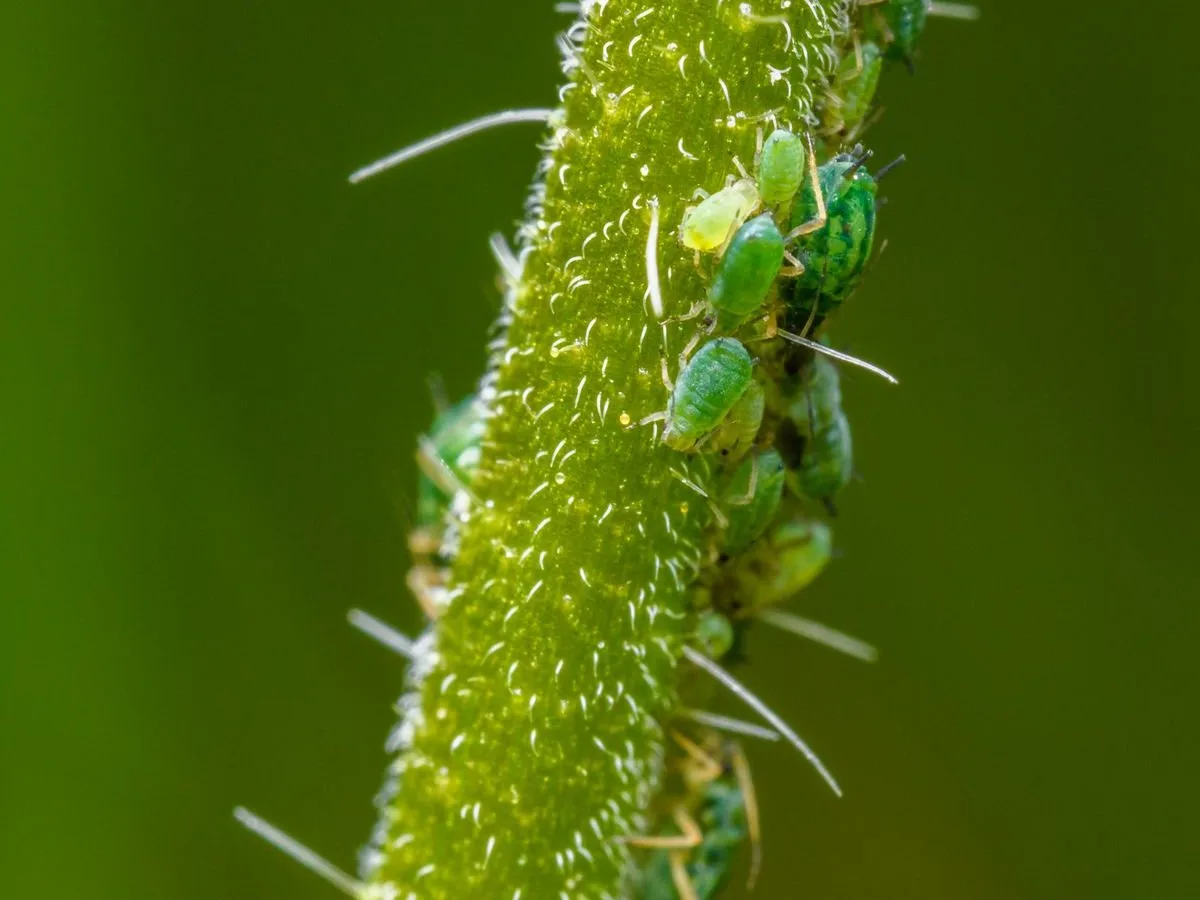
The signs are curled, yellowing new leaves and a sticky substance called “honeydew” that drips onto the leaves below. Sometimes you will see ants climbing the pot: they love honeydew and even protect the aphids.
- Small infestation: squash them with your fingers or wash them off with a stream of water in the sink.
- Bigger infestation: cut off the worst tips and spray soap solution every three days.
- Go easy on fertilizer: too much nitrogen makes soft, tender shoots that aphids love.
The University of California’s pest management program explains the aphid life cycle and control options in detail.
Spider mites
Spider mites are not insects. They are related to spiders and are so small they look like specks of dust. The most common one indoors is the two-spotted spider mite, which spins very fine webs, mostly on the plant’s tips.
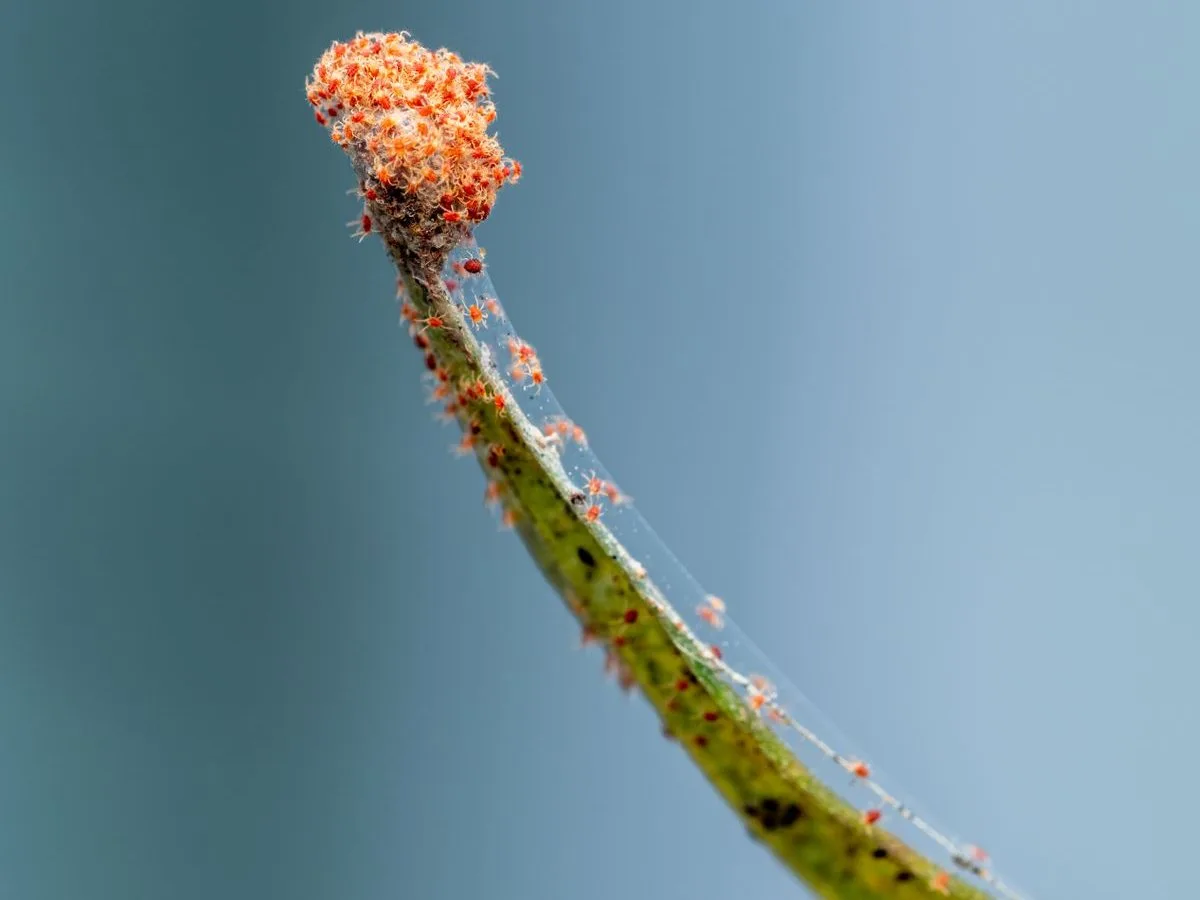
The leaf becomes covered in tiny yellow or whitish dots, as if it had been hit by a shower of sand. Later, it loses its color, dries out and falls. Basil, mint and rosemary are often hit hard.
Spider mites love warm, dry air. That is why they appear more in summer, near very hot windows and in rooms with air conditioning or heating.
- Rinse the leaves with water, top and bottom, twice a week.
- Raise the humidity by setting pots on a tray of pebbles and water (without the water touching the bottom of the pot).
- Spray soap solution every three to five days for three weeks, because eggs keep hatching.
- Move the pot away from air vents.
The National Pesticide Information Center has a clear page on how to recognize and manage spider mites.
Mealybugs and scale
Mealybugs look like tiny bits of cotton stuck to the stems and the undersides of leaves. Scale insects look like small brown shells. They barely move, so many people think it is a disease rather than a bug.
Both release honeydew, which makes the plant sticky and can attract a black fungus called sooty mold. On herbs, they show up most on rosemary, thyme and mint.
- Remove them one by one with a cotton swab dipped in rubbing alcohol.
- Cut off heavily infested stems.
- Spray soap solution for three weeks to catch new ones as they hatch.
Whiteflies
Whiteflies are very small white insects that live under the leaves. When you touch the plant, a little white cloud rises. They suck the sap and leave the leaves yellow and sticky.
A yellow sticky trap, sold in garden stores, helps catch the adults, because they are attracted to the color. Combine it with soap solution sprayed under the leaves, where the eggs and young ones live.
Fungus gnats
Fungus gnats are small black flies that hover near the soil. The adults are just annoying. The real problem is the larvae, which live in the top inch or two of damp soil and can feed on the fine roots of seedlings.
They almost always appear for one reason: soil that stays wet all the time. The main fix is to let the top of the soil dry out between waterings. A thin layer of coarse sand on top of the soil also helps, because the gnats cannot lay eggs there. The full step-by-step is in our guide to fungus gnats.
If your soil is always soggy, read our article on overwatered herbs. And if the flies hang around your kitchen scraps instead, see how to deal with fruit flies in a compost bin.
Caterpillars
Caterpillars show up mostly on herbs kept on a balcony or near open windows, because butterflies and moths lay eggs on the leaves. The sign is easy to spot: chewed leaves, big holes and small dark droppings.
In pots, the best method is picking them off by hand. Look under the leaves, ideally in the evening, when they are most active. Parsley and dill, for example, can host large butterfly caterpillars that eat fast.
Thrips
Thrips are thin, elongated insects, smaller than a grain of rice. They scrape the leaf surface and leave silvery streaks with tiny black dots. They are hard to see, but they show up when you shake a stem over a sheet of white paper.
The treatment is similar to spider mites: rinse the leaves, remove the worst ones and spray soap solution for a few weeks.
How to make a mild soap spray
A soap spray is the simplest and safest way to control soft-bodied pests at home. The soap breaks down the protective layer on the insect’s body, and it dies. But it only works on contact, so you need to spray thoroughly.
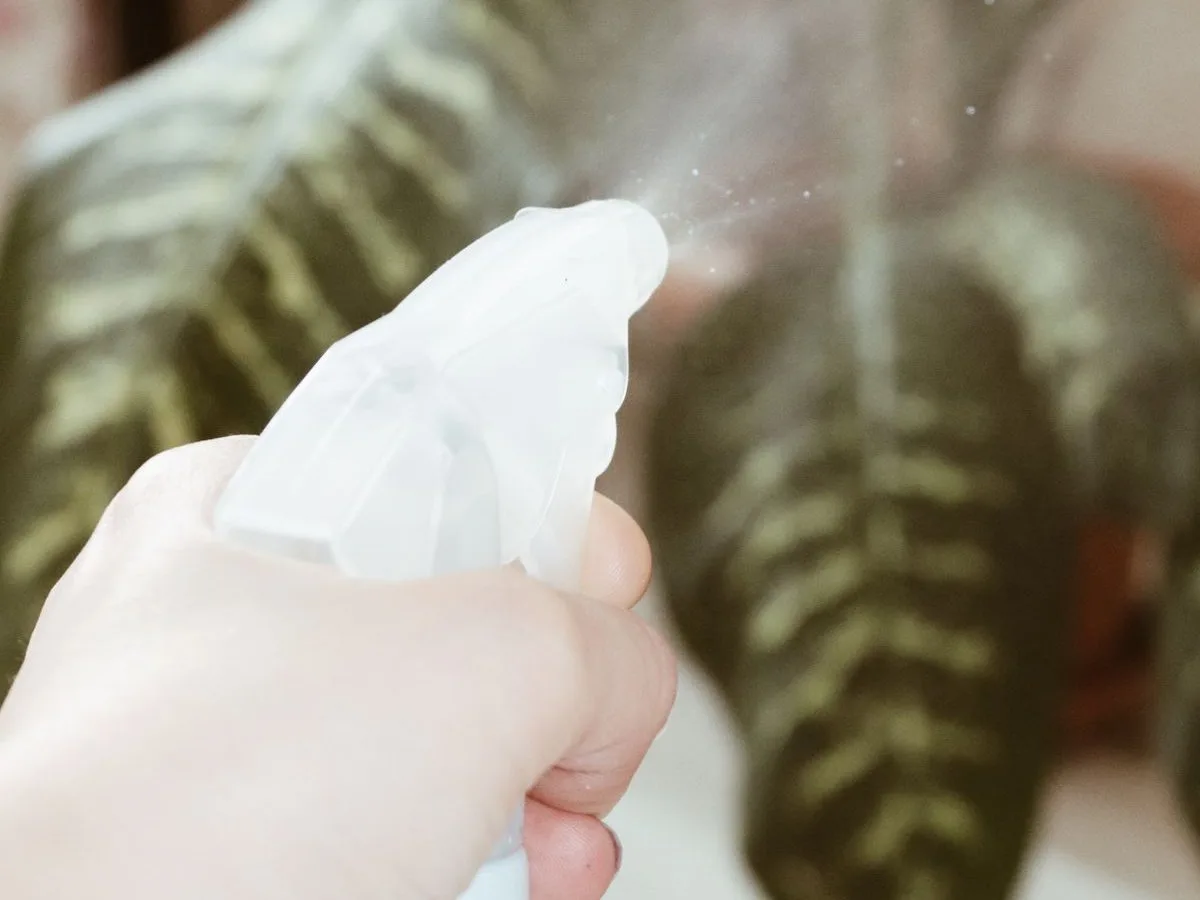
- Mix 1 teaspoon of pure castile soap or mild, unscented dish soap into 1 quart (1 liter) of water.
- Pour it into a clean spray bottle.
- Test on one leaf and wait 24 hours to make sure it does not burn.
- Spray the tops and undersides of the leaves in the late afternoon, out of strong sun.
- Repeat every three to five days for two or three weeks.
- Rinse the leaves with water before cooking with them.
Avoid laundry detergent, scented dish soap and products with degreasers. And do not make it stronger thinking it will work better: too much soap burns the leaves, especially on basil and cilantro.
What about neem oil?
Neem oil is a natural product made from the seeds of the neem tree. It helps against aphids, spider mites, mealybugs and whiteflies by disrupting how the insects feed and grow.
On herbs, though, use it carefully. Choose a product labeled for edible plants and follow the dose and the waiting time before harvest shown on the label. It has a strong smell and can leave a taste on the leaves. For beginners, a soap spray is usually enough.
The University of Minnesota Extension also has a helpful overview of common indoor plant pests and gentle ways to control them.
What NOT to use on herbs
- Household bug spray (for roaches and mosquitoes): it is not made for plants and must never go on food.
- Rubbing alcohol sprayed on the whole plant: it burns the leaves. Use it only on a cotton swab, on mealybugs.
- Vinegar or bleach recipes: they can burn and kill the plant.
- Tobacco tea: nicotine is toxic to people and pets.
Pests on each herb
- Basil: aphids, spider mites, whiteflies and caterpillars. Pinching off flowers and harvesting often keeps the plant strong. See how to grow basil in a pot.
- Mint: spider mites and aphids, especially when it gets too dry. Since it grows fast, you can cut off affected parts without worry. See how to grow mint in a pot.
- Parsley: aphids and butterfly caterpillars. Harvest the outer leaves and check the center of the plant. See how to grow parsley in a pot.
- Green onions: usually have few pests, but thrips can show up. Cutting the leaves about 2 inches (5 cm) above the base renews the plant. See how to grow green onions in a pot.
- Rosemary and thyme: mealybugs and spider mites, especially in stuffy spots. They like sun and drier soil.
- Cilantro: aphids, especially once it starts to flower.
How to isolate and clean an infested pot
As soon as you find a pest, move the pot away from your other plants. Aphids, spider mites and whiteflies spread easily from one plant to the next, especially when pots touch.
Check the neighboring pots too, under the leaves. Wipe the saucer, the shelf and the wall near the pot with a damp cloth, because eggs and bugs can stay there.
Keep the pot apart until at least two weeks have passed with no sign of pests. Only then put it back with the others.
Pests in summer and winter
In summer, the heat speeds everything up. Spider mites, aphids and whiteflies multiply very fast. Check under the leaves at least once a week and rinse your plants with water more often.
In winter, herbs grow slowly and spend more time indoors, near heaters and closed windows. Dry air favors spider mites, and soil that takes long to dry favors fungus gnats. See our seasonal tips on how to grow herbs in winter.
Common mistakes when fighting pests
- Spraying only once. The spray kills the bugs but not the eggs. Without repeating, the pests come back in a few days.
- Spraying only the tops. Most pests live under the leaves.
- Spraying in strong sun. Spray plus sun can burn the leaves.
- Ignoring the cause. If the plant still lacks light or sits in soggy soil, the pests will return.
- Putting a new plant right next to the others. Keep new plants apart for a week and check them first.
How to prevent herb plant pests
- Give them light: keep pots in the brightest spot in your home. If your plant is tall and thin, see leggy herbs.
- Water wisely: only when the top of the soil is dry.
- Fertilize lightly: too much fertilizer makes soft shoots that attract aphids.
- Let air circulate: do not cram pots together.
- Harvest often: regular harvesting renews the plant and removes old leaves.
- Look under the leaves once a week.
- Quarantine new plants for a week before putting them with the others.
If your leaves are yellowing and you cannot find any bugs, the cause may be something else. Use the table in our article on herb leaves turning yellow. And to set up a healthy herb garden from the start, see our complete kitchen herb garden guide.
- Check under the leaves and on new tips: that is where most pests hide.
- Water, mild soap and patience solve most indoor cases.
- Repeat the soap spray for two or three weeks, because it does not kill the eggs.
- A strong plant with good light and the right watering rarely suffers from pests.
- Herbs are food: avoid insecticides and rinse the leaves before eating.
Frequently asked questions about herb plant pests
Can I eat herbs that had pests?
Yes, as long as you did not use anything toxic. Remove the badly damaged leaves, rinse the rest well under running water and use them as usual. If you sprayed soap solution, rinse the leaves before cooking.
How long does it take to get rid of aphids?
With a water spray and soap solution every three days, most infestations are gone in two to three weeks. The key is not to stop halfway, because new aphids keep hatching in the first few days.
Are ants in the pot a problem?
Ants alone rarely harm herbs. But they usually show up because aphids or mealybugs are producing honeydew. Look for those pests under the leaves and treat the plant. Once they are gone, the ants leave too.
Do coffee grounds keep pests away?
There is no good evidence that coffee grounds repel aphids or spider mites. Spread thickly on the soil, they can even hold moisture and attract fungus gnats. The best place for coffee grounds is the compost bin.
Does cinnamon help with fungus gnats?
Some people sprinkle cinnamon on the soil, but what really works is letting the top of the soil dry out between waterings. Without constantly damp soil, the larvae cannot survive.
My herb has webs. Is it a spider?
Almost always, it is spider mites. Their webs are very fine and sit on the tips and between leaves, along with tiny yellow dots. Rinse the plant well, raise the humidity and use soap solution for three weeks.
When should I throw the plant away?
When pests have taken over almost the whole plant, the leaves are dry and there are no healthy new shoots. In that case, it is safer to discard the plant, wash the pot with soap and water and start again with fresh soil.
Do herbs by the window get more pests?
They can, because an open window lets in insects and butterflies. Even so, it is still the best spot for herbs because of the light. Checking under the leaves every week is a better idea than moving the pot away from the window.