Grow Lights for Herbs: Hours, Distance and the Best Type
Grow lights for herbs are the answer when you want fresh basil, rosemary, and parsley indoors but don’t have a sunny window. A simple LED fixture on a timer can keep herbs and microgreens growing strong on a kitchen counter, a bookshelf, or even inside a cabinet, all winter long.
In this guide, you’ll learn when a grow light is worth it, which type of bulb to choose, what color of light to use, how many hours to leave it on, how far to place it from your plants, how much it costs to run, and how to tell if the light is too weak or too strong.
When a grow light is worth it
Most herbs love sun. Illinois Extension says herbs usually need six to eight hours of bright light each day. In winter, few windows come close to that, especially in northern states.
A grow light makes sense when:
- Your window doesn’t get direct sun: in the US, north-facing windows are the dimmest.
- Buildings or trees block the view: the room looks bright to you, but it’s dim for plants.
- Days are short: from November to February, even a good window loses hours of sun.
- Your herbs are tall and floppy: that’s the most common sign of low light.
- You want to grow away from a window: on a counter, shelf, or bookcase.
Before buying a light, check out the herbs that grow in low light. Mint, parsley, and chives handle dimmer spots well. For basil, rosemary, and thyme, extra light makes a big difference.
Which type of grow light to choose
There are several types of bulbs, but for home growers today the choice is almost always LED. Here’s how they compare:
| Type | Heat | Energy use | Good for herbs? |
|---|---|---|---|
| Incandescent | High | High | No |
| Fluorescent tube (T5/T8) | Low | Medium | Yes, very close to the leaves |
| Regular LED (shop light) | Low | Low | Yes, for leafy herbs and seedlings |
| LED grow light | Low | Low | Yes, the best option |
Incandescent bulbs are the worst choice. UConn’s Home & Garden Education Center explains that they release 90% of their energy as heat and are the least efficient. They warm the leaves long before they give enough light.
The good news is you don’t need anything expensive to start. Mississippi State University Extension says you don’t need special grow lights: shop LED or fluorescents will work. The same source notes that LEDs run cooler, use less energy, and last longer.
Shop light or real grow light?
A regular white LED shop light, hung close to the plants, keeps leafy herbs and microgreens healthy. Dedicated grow lights are stronger and spread light more evenly. They’re worth it for sun lovers such as basil, rosemary, peppers, and cherry tomatoes.
When shopping, choose a fixture with adjustable height so you can raise it as plants grow. Clip-on gooseneck lights and fixtures that hang from the shelf above are the most practical for small spaces.
What color of light is best?
Plants use mostly blue and red light. UConn sums it up: blue light promotes leafy growth, and red light supports flowers and fruit. That’s why many grow lights glow purple, a mix of both colors.
For herbs in your kitchen, white full-spectrum light is usually the better choice. It includes blue and red, shows your plants in their true colors, and is easy on the eyes. Purple light works, but it’s tiring to look at and hides warning signs like yellowing leaves.
One key point: UNH Extension notes that when plants fail under lamps, the problem is more often light quantity than light quality, or spectrum. In other words, a strong white light placed close beats a weak purple one hung far away.
How many hours to leave grow lights on
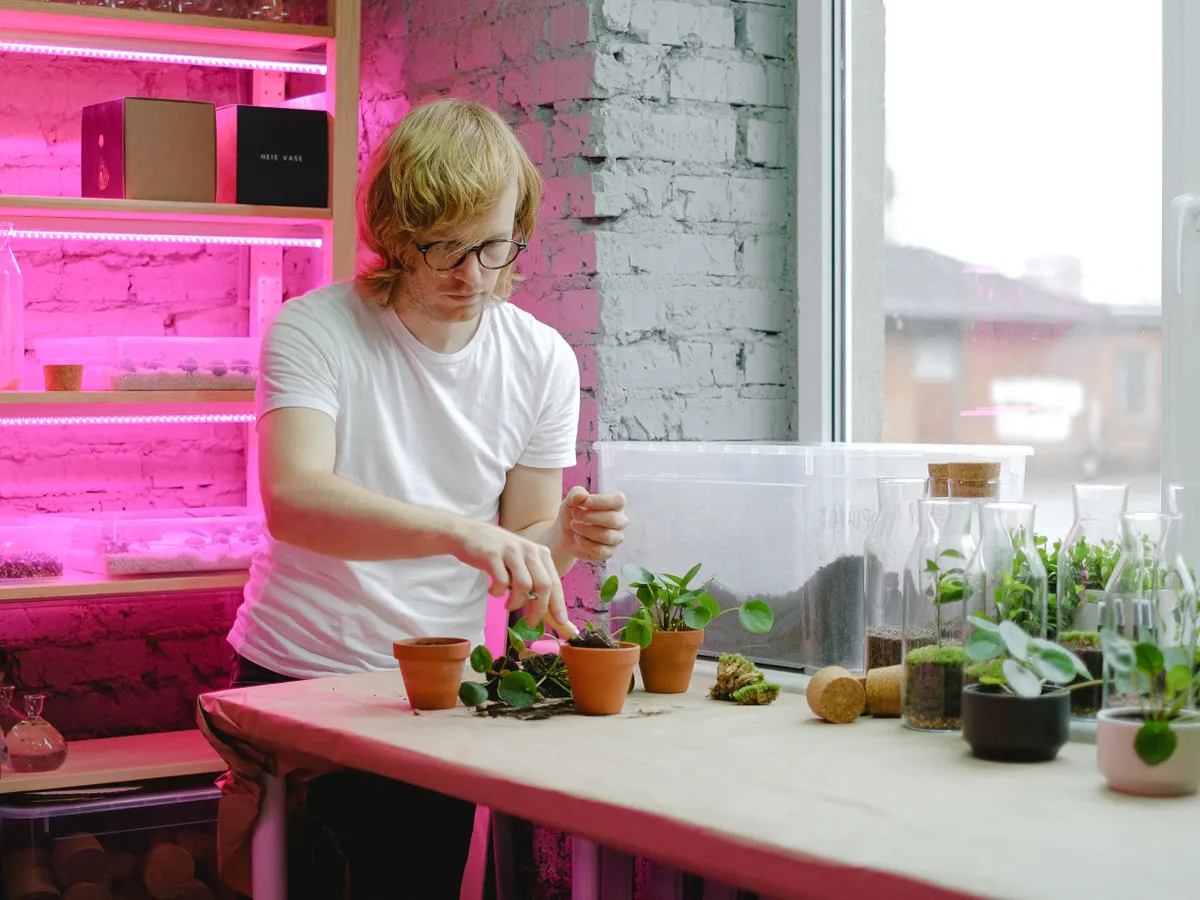
UConn suggests about 12 hours of light a day for herbs and greens, and 14 to 16 hours for seedlings. Illinois Extension explains that lamp light is weaker than sunlight: plants need about two hours of supplemental light for every one hour of natural light.
In practice, most herb lights run 12 to 16 hours a day. Go toward the higher end when your light is weak or when it’s the only light source.
- Use a timer: Illinois Extension recommends an automatic timer so lights turn on and off at the same time each day. A basic outlet timer works.
- Don’t run it 24/7: UConn warns that light around the clock isn’t ideal and can overwhelm the plant.
- Combine with your window: if your herbs get a few hours of sun, the light just fills in the rest of the day.
How far grow lights should be from plants
Distance changes light intensity a lot. The closer the light, the more reaches the leaves. That’s why sources give different distances depending on the type of fixture:
| Type of light | Distance from leaves |
|---|---|
| Household LED or fluorescent tube | 4 to 6 inches |
| LED grow light fixture | 6 to 12 inches |
| High-power LED panel | Follow the manufacturer’s directions |
UNH Extension suggests 4 to 6 inches for household LED or fluorescent lamps. UConn recommends about 12 inches for grow light fixtures. Start in the middle and adjust based on how your plants respond.
A simple test: hold your hand at leaf level under the light for 30 seconds. If it feels uncomfortably warm, the light is too close. LEDs run cool, but powerful panels can still dry out and bleach the top leaves.
Signs your grow light setup is wrong
Not enough light
- Long, thin, floppy stems.
- Wide gaps between leaves.
- Small, pale green leaves.
- The whole plant leaning toward the light.
UNH Extension puts it simply: if seedlings are stretched and pale, they need more light. Lower the fixture or run it longer. Learn how to bring plants like this back in our guide to leggy herbs.
Too much light
- Top leaves faded, whitish, or yellowed.
- Crispy tips or scorched spots.
- Soil drying out very fast.
If you see these signs, raise the fixture a couple of inches or cut back the hours. Yellow leaves can also come from watering or feeding problems. See how to tell them apart in our guide to herb leaves turning yellow.
How much light each herb needs
Not all herbs need the same light. Group plants with similar needs under the same fixture:
| Group | Herbs | How to light them |
|---|---|---|
| High light | Basil, rosemary, thyme, oregano, sage, peppers, cherry tomatoes | Center of the fixture, close, 14 to 16 hours |
| Medium light | Parsley, chives, cilantro, mint, lemon balm | Edges of the fixture, 12 to 14 hours |
| Microgreens | Radish, arugula, kale, sunflower | 6 to 12 inches, about 16 hours |
Light is always strongest at the center of a fixture and weaker at the edges. Use that to your advantage: put basil and rosemary right in the middle, and parsley and chives near the edges.
For microgreens, one fixture over the tray is enough. The full step-by-step is in our guide on how to grow microgreens.
How to set up an indoor herb light station
- Pick a spot: a counter, shelf, or bookcase near an outlet and away from the sink.
- Mount the light above: under the shelf above, on a stand, or with a clip-on arm.
- Keep the height adjustable: chains, hooks, or an adjustable stand make it easy to raise.
- Use a light background: a white wall or foil behind the pots bounces light back to the plants.
- Plug into a timer: and pick hours that won’t disturb anyone’s sleep.
- Rotate the pots: once a week, so plants grow evenly.
A bookcase with two or three lit shelves becomes a small indoor garden. For more setup ideas, see our guide to a vertical garden in an apartment.
How much grow lights cost to run
LEDs use little power. For example, a 20-watt fixture running 14 hours a day uses about 8.4 kWh a month. At around 17 cents per kWh, that’s roughly $1.50 a month. Check the wattage on the box and the rate on your electric bill for your own numbers.
Mississippi State notes that LEDs cost more up front but pay for themselves over time, since they use less energy and last longer. If you buy fresh herbs every week, the math usually works out fast.
Safety tips
- Keep water away from outlets: place cords and timers away from saucers and watering.
- Choose certified products: look for a UL or ETL listing on the package.
- Don’t stare into strong LEDs: especially purple ones, which strain the eyes.
- Think about kids and pets: secure fixtures well and tuck cords out of reach.
Common grow light mistakes
- Light too far away: plants stretch even with the lamp on all day.
- Using incandescent bulbs: lots of heat, little useful light.
- Running lights 24 hours: plants need a dark period.
- Forgetting to switch it on and off: without a timer, the schedule falls apart.
- Not raising the light: the plant grows up and touches the lamp.
- Watering on the same schedule as before: under lights, soil dries faster. Check before watering.
Grow lights are especially helpful in the cold months, when herbs grow slowly. See how to care for them this time of year in our guide to growing herbs in winter. And if you’re building your garden from scratch, start with our kitchen herb garden guide.
- Use a grow light when your window lacks direct sun or your herbs are getting leggy.
- LED is the best choice: it runs cool, uses little energy, and lasts longer.
- White full-spectrum light works well and is easy to live with.
- Run lights 12 to 16 hours a day on a timer, never 24 hours.
- Hang them 4 to 6 inches (shop lights) or 6 to 12 inches (grow lights) above the leaves.
- Tall, pale plants need more light; bleached leaves need the light farther away.
- Put basil and rosemary in the center of the fixture, parsley and chives at the edges.
With one simple fixture and a timer, any corner of your home can grow strong, fragrant herbs all year round.
Grow lights for herbs FAQ
Can I use a regular LED bulb for herbs?
A regular white LED helps if it’s very close to the leaves. For sun-loving herbs, a dedicated grow light works better.
How many hours a day should grow lights be on?
Run them 12 to 16 hours a day for most herbs. Use a timer and never leave them on 24 hours.
How far should a grow light be from herbs?
About 4 to 6 inches for household LED or fluorescent tubes, and 6 to 12 inches for grow light fixtures. Adjust based on how plants respond.
Is purple or white grow light better?
Both work. Indoors, white full-spectrum light is more practical because it shows true leaf color and is easier on the eyes.
Can grow lights replace sunlight?
Yes, but they’re weaker than the sun. That’s why plants need more hours under a lamp than they would in direct sun.
How do I know if my herbs need more light?
They grow tall, thin, and pale, with wide gaps between leaves, and lean toward the light.
Do grow lights use a lot of electricity?
No. A 20-watt LED running 14 hours a day uses about 8.4 kWh a month, usually just a dollar or two.
Can I use grow lights for microgreens?
Yes, and they work very well. Keep the light 6 to 12 inches above the tray for about 16 hours a day.